The Architecture of Chaos: Leading Through the Half-Life of Certainty
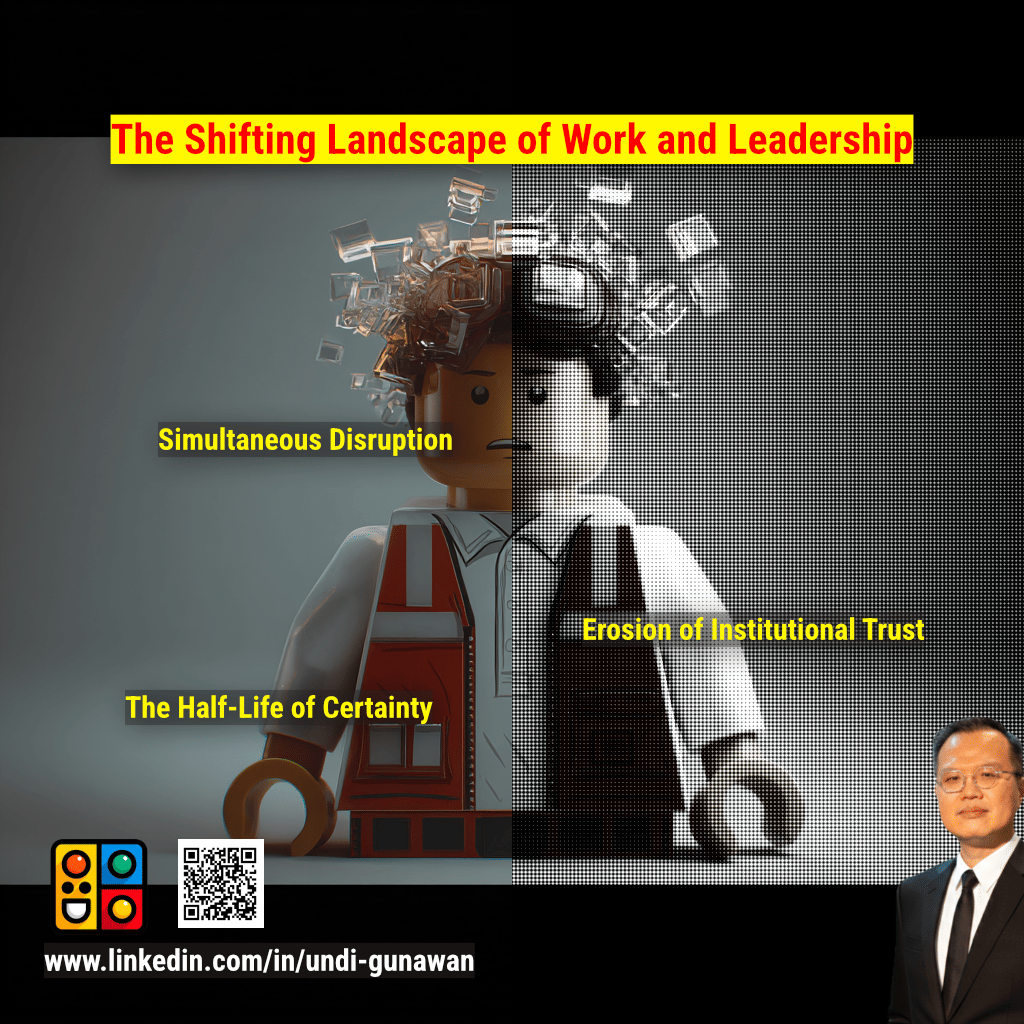
We are living through a historical anomaly. Human beings have always navigated change, but our current era is fundamentally different. It is defined not by linear adaptation, but by simultaneous disruption. We are witnessing a rare, volatile collision where demographic shifts, economic pressures, changing employee expectations, and rapid artificial intelligence development are all hitting the organizational landscape at the exact same moment.
For leaders, this creates an exhausting reality: the half-life of certainty has collapsed. The knowledge, frameworks, and competitive advantages that used to guarantee a decade of stability now degrade in a matter of months. Strategies can no longer be static monuments; they must be living, breathing, and constantly revisited organisms.
Compounding this operational friction is a profound cultural undercurrent: the systemic erosion of institutional trust. Across society, faith in foundational pillars—the military, government, science, universities, media, and business—has steadily decayed. This skepticism does not stop at the office door. Employees no longer give corporate messaging the benefit of the doubt. When trust is low and uncertainty is high, traditional top-down leadership models do not just fail—they backfire, inducing cynicism and paralysis.
To survive this landscape, organizations must abandon the illusion of a predictable future. Instead, they must cultivate systemic resilience, psychological safety, and real-time strategic agility.
The Limits of the Written Word in Crisis #
When faced with unprecedented complexity, the standard corporate reflex is to write: more reports, more white papers, more bulleted slide decks. But language is highly subject to political manipulation, filtering, and safe, optimized corporate speak. In a low-trust environment, text-heavy strategic plans are often perceived as hollow propaganda.
Furthermore, traditional 2D mediums fail to capture complex, non-linear relationships. When multiple disruptions collide, the human brain struggles to map out the cascading feedback loops purely through conversation or text. To unlock true strategic clarity and rebuild internal trust, organizations must change the medium of execution. This is where 3D modeling and embodied metaphor become essential strategic tools.
Constructing Clarity: The Role of LEGO® SERIOUS PLAY® #
The LEGO® SERIOUS PLAY® (LSP) methodology addresses these systemic challenges by leveraging the hand-brain connection. Neurologically, our hands are deeply connected to our cognitive processes. When leaders are tasked with physically building abstract concepts—such as “our market vulnerabilities” or “the impact of AI on our workforce"—they access latent knowledge and insights that remain suppressed during standard verbal debates.
By externalizing complex internal dynamics into tangible, physical models, LSP alters the communication architecture of a room:
- 100% Participation and Inclusion: Traditional meetings are typically dominated by the loudest or most senior voices. LSP requires every participant to build and share their story, leveling the playing field and surfacing critical frontline insights.
- Depersonalized Conflict: When a strategic threat or internal failure is modeled in Lego bricks on a table, the criticism is directed at the physical model, not the person who built it. This creates immense psychological safety, allowing teams to confront hard truths without triggering defensiveness.
- Shared Landscape Realism: Organizations can connect individual models to construct a comprehensive, real-time map of their entire operational ecosystem. This allows leadership teams to simulate complex disruptions and test systemic interventions visually and dynamically, matching the speed of the half-life of certainty.
Three Key Takeaways #
Navigating the Collision, Not the Variable
Leaders can no longer isolate disruptions. You are not managing an "AI transition” or a “remote work shift” in a vacuum. Survival requires frameworks that model the simultaneous collision of these factors and their compounding effects on organizational trust.Embracing the Fluidity of Strategy
Because the half-life of certainty has dropped precipitously, competitive advantages decay rapidly. Organizations must shift from rigid, multi-year planning cycles to dynamic, real-time strategic modeling that can be updated as fast as the market shifts.Rebuilding Trust Through Tangible Metaphor
Overcoming the erosion of institutional trust requires radical transparency and equalized voices. Leveraging embodied methodologies like LEGO® SERIOUS PLAY® democratizes strategy, breaks through corporate posturing, and fosters authentic alignment.
Let’s talk.