The Non-Linear Career Arc & The Power of Mature Expertise
The traditional, linear career arc—that predictable, comforting climb from junior associate to senior executive, followed by a gold watch and a quiet retirement—has quietly evaporated. In its place, we have been handed a volatile, non-linear “zigzagging” path. Today, the concept of a career trajectory is no longer defined by a straight line, but by a series of distinct, often disruptive reinventions. Professionals are no longer settling into their final roles as they mature; instead, they are frequently restarting, pivoting, and completely re-engineering their professional identities in their 40s, 50s, and even their 60s.
This structural shift has brought about an acute modern market dilemma. When veteran professionals face displacement past the age of 50, they run headfirst into a frustrating economic wall, struggling to secure new roles that match their hard-earned previous salary levels. A prominent, systemic anxiety has taken root across the global workforce: has veteran experience ceased to be an asset? In the eyes of cost-cutting employers and automated recruitment algorithms, has a long resume transitioned into a liability and a corporate risk?
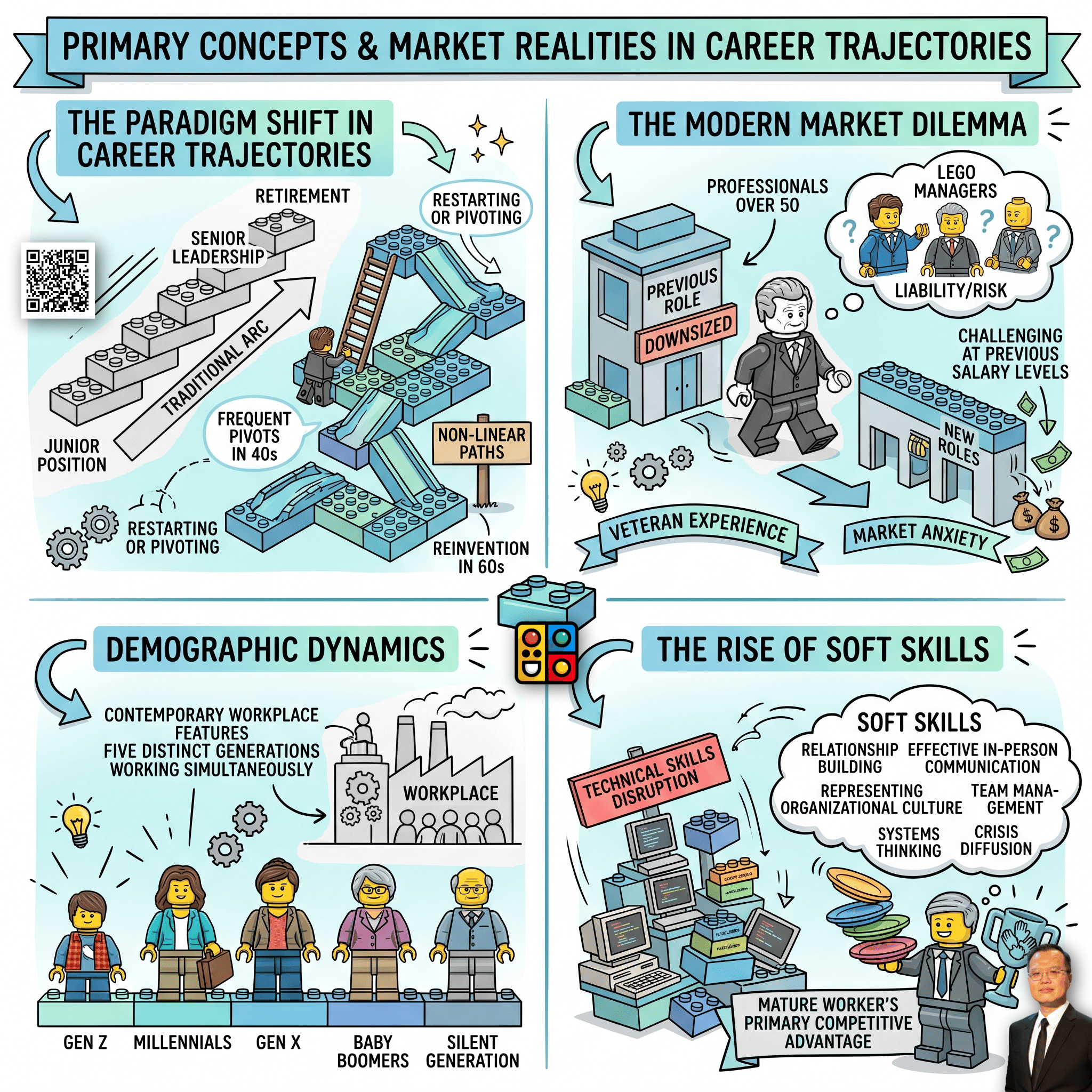
To unlock this dilemma, we have to look closely at the unique demographic dynamics of the contemporary workspace. For the first time in industrial history, the workplace features five distinct generations working simultaneously. Managing, collaborating, and surviving within this multi-generational matrix requires an entirely different playbook—one that moves past technical execution and relies on the strategic activation of mature human capability.
Key Takeaways from the New Career Paradigm #
- The Devaluation of Purely Technical Longevity Technical skills are facing unprecedented, rapid disruption. Relying on veteran technical expertise as your primary value proposition is a high-risk strategy, as employers increasingly view long-term technical specialization through the lens of salary risk and adaptability liabilities.
- The Five-Generation Collaboration Challenge The modern corporate environment is culturally and operationally fragmented, requiring a rare type of organizational stewardship. Success in this five-generation ecosystem belongs to those who can act as cultural translators and operational anchors.
- Soft Skills as the Ultimate Competitive Asset True competitive advantage for mature workers lies in institutional soft skills: relationship building, effective in-person communication, representing organizational culture, team management, macro-level systems thinking, and high-stakes crisis diffusion.
As the market continues to evolve, the professionals who thrive will not be those who try to out-sprint younger generations in technical fluency. Instead, victory belongs to the veteran workers who understand that their maturity is an ecosystem stabilizer. By reframing your narrative around systems thinking and crisis diffusion, you transform your veteran status from a perceived risk into an absolute organizational necessity.