Scale vs. Sparsity: Eliminating Structural Capital Drag via the LEGO® SERIOUS PLAY® Methodology
Can a mature enterprise achieve market-disrupting product efficiency, completely bypass an escalating industry capital expenditure war, and protect its long-term operating margins?
Yes—by taking strategic inspiration from a fruit fly.
When Sarah Laszlo and her team at Google X launched Project Valkyrie, they began with a 3D, nanometer-resolution map of the fruit fly brain. By porting its structural connectivity into an AI framework called reservoir computing, they achieved a stunning result: an image segmentation model for autonomous drones that matched state-of-the-art accuracy but trained in just 6 steps instead of the usual 50,000.
When leadership teams look at market disruption, they often default to a bigger-is-better mentality, assuming the only way to outpace the competition is to outspend them on the exact same resource roadmap. By porting a lean, high-leverage architectural framework into a corporate restructuring strategy, an enterprise can achieve a stunning result: an operational model that matches top-tier market performance but executes in a fraction of the time, bypassing the usual bloated corporate overhead.
The biological brain had instinctively optimized a mathematical principle of connection density that human engineers were still trying to solve with physics. Biology has spent millions of years solving for extreme efficiency.
But here is where the story gets deeply instructive for any business leader or founder:
When organizations run rigorous diagnostic controls on highly agile business units, they discover the magic isn’t a complex, multi-layered management framework. It is the deliberate sparsity of the network. The most resilient corporate ecosystems instinctively optimize a principle of lean connection density that traditional human resource planners are still trying to solve with heavy, top-down hierarchy.
Market dynamics have spent decades proving that extreme efficiency outlasts brute force. If your current business strategy is simply “expand the headcount and buy more market share,” you might be building on a massive structural misstep.
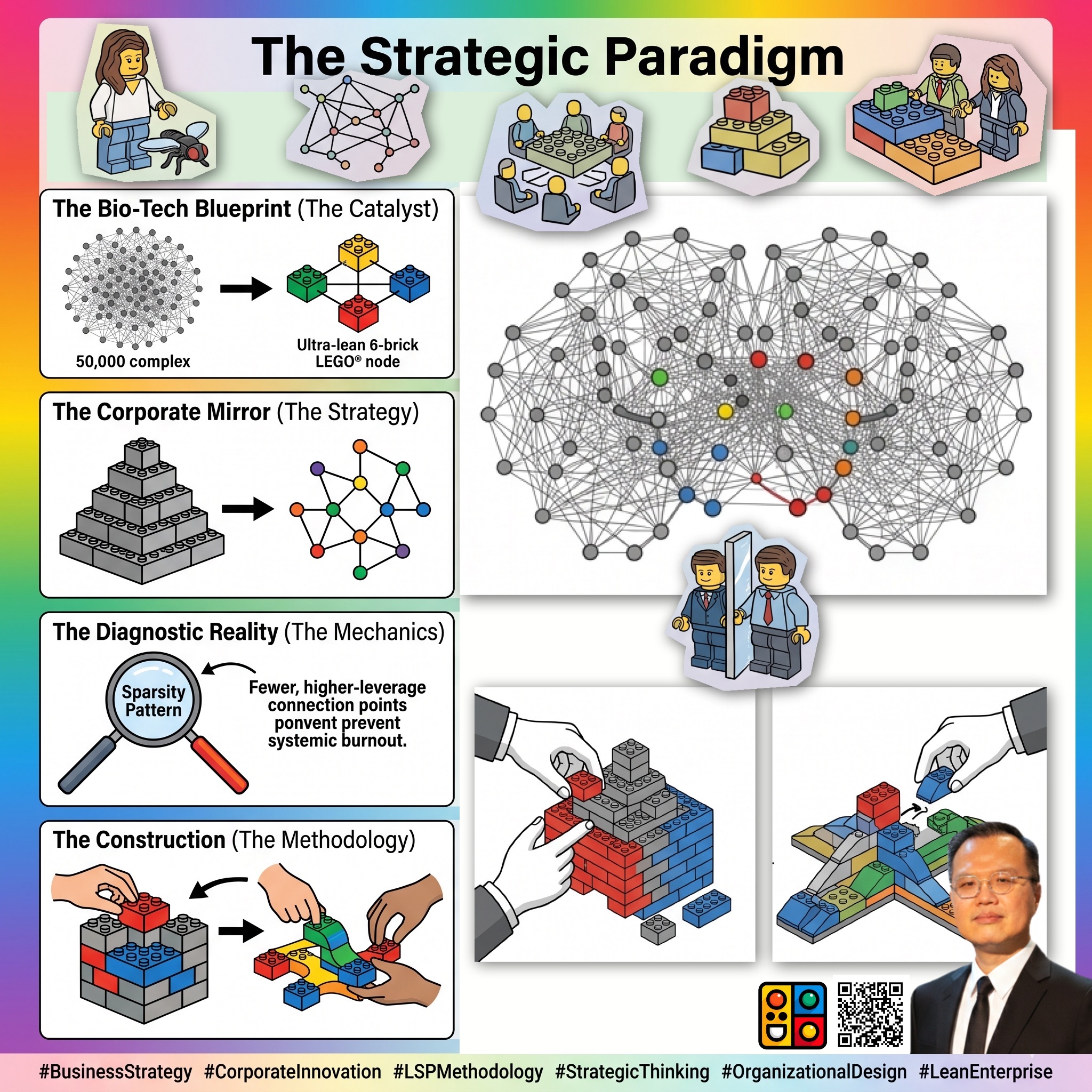
This is precisely where strategic imagination and the LEGO® SERIOUS PLAY® methodology become critical drivers of corporate survival. Traditional executive boardrooms are plagued by cognitive entrenchment, where leaders look at a business model and only see the existing corporate hierarchy. The LEGO® SERIOUS PLAY® process shatters this linear bias by forcing the hand to connect with the brain, translating abstract organizational friction into tangible, three-dimensional metaphorical models that allow a leadership team to visually inspect the density of their current strategic assumptions.
What can your industry steal from biological architectures to stop burning resources?
This is precisely where strategic imagination and the LEGO® SERIOUS PLAY® methodology become critical drivers of corporate survival. Traditional executive boardrooms are plagued by cognitive entrenchment, where leaders look at a business model and only see the existing corporate hierarchy. The LEGO® SERIOUS PLAY® process shatters this linear bias by forcing the hand to connect with the brain, translating abstract organizational friction into tangible, three-dimensional metaphorical models that allow a leadership team to visually inspect the density of their current strategic assumptions.
Through the structured process of building and storying, executives can play out real-time scenarios, physically decoupling bloated operational habits to reveal leaner, unexpected pathways to value creation. The physical blocks democratize the conversation, allowing diverse stakeholders to co-create a shared strategic landscape where invisible operational blockages become blindingly obvious. Ultimately, this creative methodology allows a leadership team to stop burning vital corporate energy on legacy processes and instead design an elegant, highly adaptive organizational architecture capable of out-maneuvering the market.