Beyond the Rebranding Trap: Building an Unshakeable Career Framework for the Veteran Professional
The prevailing narrative surrounding career longevity for mature professionals is deeply broken. For years, conventional career coaching has offered a defensive, almost apologetic playbook for individuals navigating the job market in their late classic and executive years. We have all heard the standard recommendations: sanitize your LinkedIn profile, scrub the graduation dates from your CV, limit your visible history to the last fifteen years, and avoid any historical references that might reveal your true timeline. This approach is not just exhausting; it is structurally ineffective.
When you systematically erase your professional history, you inadvertently strip away your greatest competitive advantage: your strategic maturity. Attempting to pass as a digital native with five years of experience ignores the reality that organizations are facing massive leadership voids, volatile market changes, and complex governance challenges that a junior workforce simply cannot address. The solution to navigating modern career dynamics and overcoming systemic age bias is not to hide your past, but to structurally reframe it.
True professional resilience requires shifting from a defensive posture to an offensive, data-driven strategy.
This essay explores the structural overhaul required to transform your decades of experience from a perceived liability into an undeniable boardroom asset.
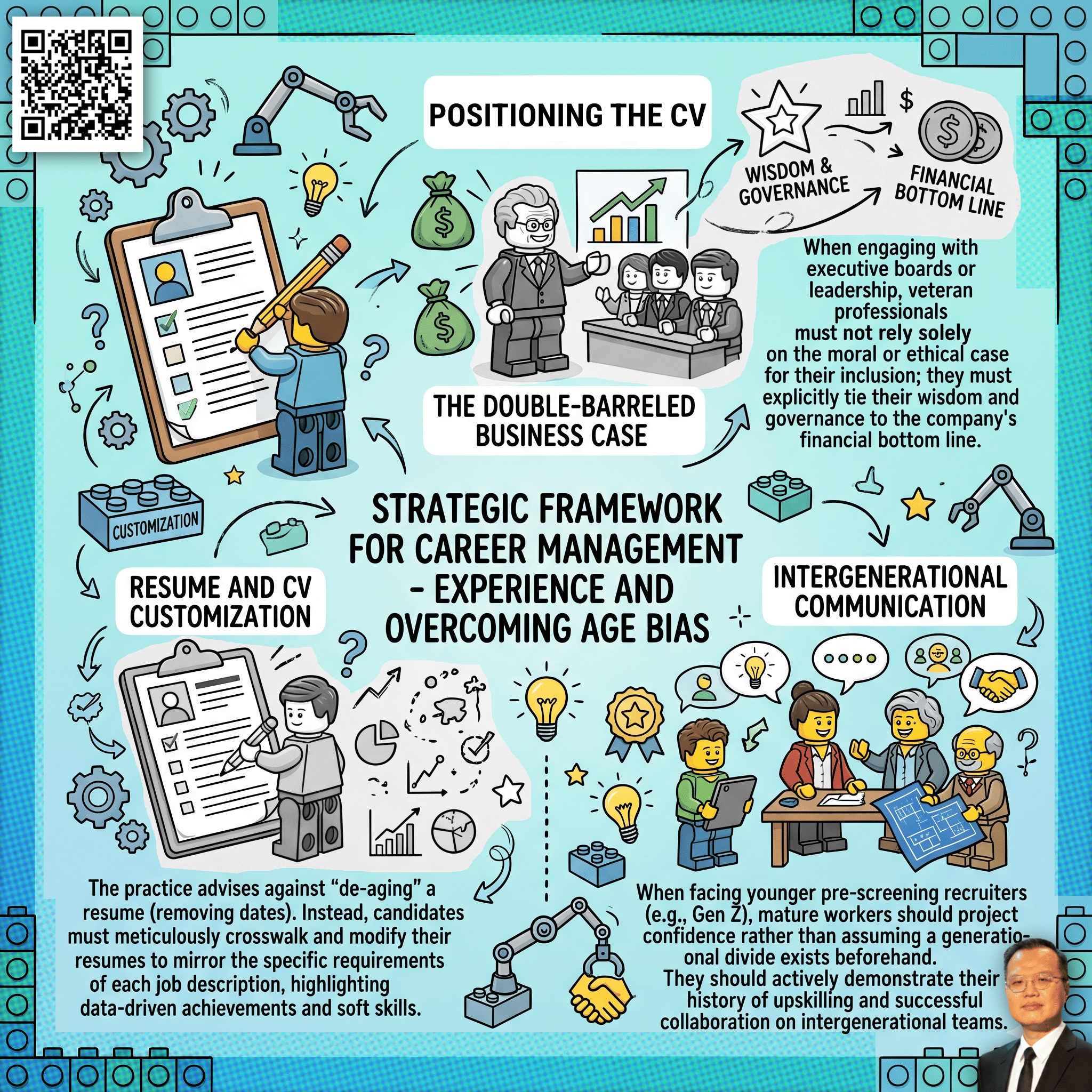
The Fallacy of “De-aging” and the Power of the CV Crosswalk #
The practice of de-aging a resume is born out of fear, and in the corporate arena, fear is a highly visible vulnerability. When an applicant tracking system or an experienced human resources director reviews a truncated CV that suddenly begins mid-career without context, it raises immediate red flags. It signals that the candidate is hiding something, creating an immediate trust deficit before the first conversation even begins.
Instead of deploying chronological smoke and mirrors, successful veteran executives practice precise alignment. This requires treating your CV not as a static historical archive, but as a living, highly customized business proposal. For every role you target, you must perform a meticulous crosswalk, systematically breaking down the specific operational, financial, and cultural requirements outlined in the job description.
Once these needs are mapped, you reconstruct your professional narrative to mirror those exact challenges. If a company is seeking a leader to navigate an organizational restructuring, your history of managing market downturns in the early 2000s becomes highly relevant—provided it is framed correctly. Every historical milestone retained on your resume must be anchored by two elements: data-driven achievements and demonstrable soft skills. Instead of merely listing past responsibilities, focus the narrative on the quantifiable metrics of your output: revenue generated, overhead reduced, teams stabilized, and risks mitigated. By anchoring your tenure in hard data, you transform abstract time into concrete institutional value.
The Double-Barreled Business Case: Moving Past the Moral Argument #
One of the most common tactical errors made by seasoned professionals is relying on an ethical or moral argument for inclusion. While diversity, equity, and inclusion initiatives are vital components of modern corporate culture, appealing strictly to an organization’s sense of fairness or respect for seniority is a highly volatile strategy when engaging with executive boards or compensation committees.
When corporate leaders gather behind closed doors to evaluate senior talent, their primary mandate is fiscal responsibility and risk management. To secure high-level buy-in, you must present a double-barreled business case that directly connects your veteran governance with the organization’s financial bottom line.
Your pitch cannot simply be that you possess deep wisdom; you must explicitly demonstrate how that wisdom acts as a financial stabilizer. For example, your experience navigating past economic cycles translates directly into predictive risk mitigation, preventing the costly missteps that less experienced leadership teams often make. If you possess deep expertise in corporate governance, frame it as a shield against regulatory penalties, litigation, and operational disruptions. When you translate your gray hair into protected profit margins and optimized operational expenditures, the perceived cost of your premium salary transforms from an expensive line-item overhead into a high-return investment.
Intergenerational Dynamics: Deconstructing the Screen before it Begins #
The initial gatekeepers of the modern hiring pipeline are frequently junior recruiters and talent acquisition specialists, many of whom belong to Gen Z or the millennial cohort. This demographic reality often induces pre-emptive anxiety in mature applicants, causing them to enter screening calls with a defensive, slightly adversarial mindset, assuming a generational divide exists before a single word is spoken.
This self-fulfilling prophecy can sabotage an interview within the first three minutes. To break through this barrier, mature workers must actively project absolute confidence in their ability to operate within fluid, modern ecosystems. This begins by proactively dismantling the stereotype of the rigid, unteachable veteran worker.
During the pre-screening phase, it is crucial to consciously highlight your ongoing relationship with upskilling. Speak comfortably about your engagement with modern platforms, emerging digital workflows, and contemporary management methodologies. Furthermore, weave explicit examples of successful intergenerational collaboration into your narrative.
Describe instances where you have mentored younger talent while simultaneously learning from their specialized insights, framing yourself as an agile, cross-functional leader who elevates the entire team dynamic.
When you show that you can seamlessly collaborate across age groups without friction, you neutralize the recruiter’s fear of cultural incompatibility, positioning yourself as the unifying force every modern enterprise requires.
–